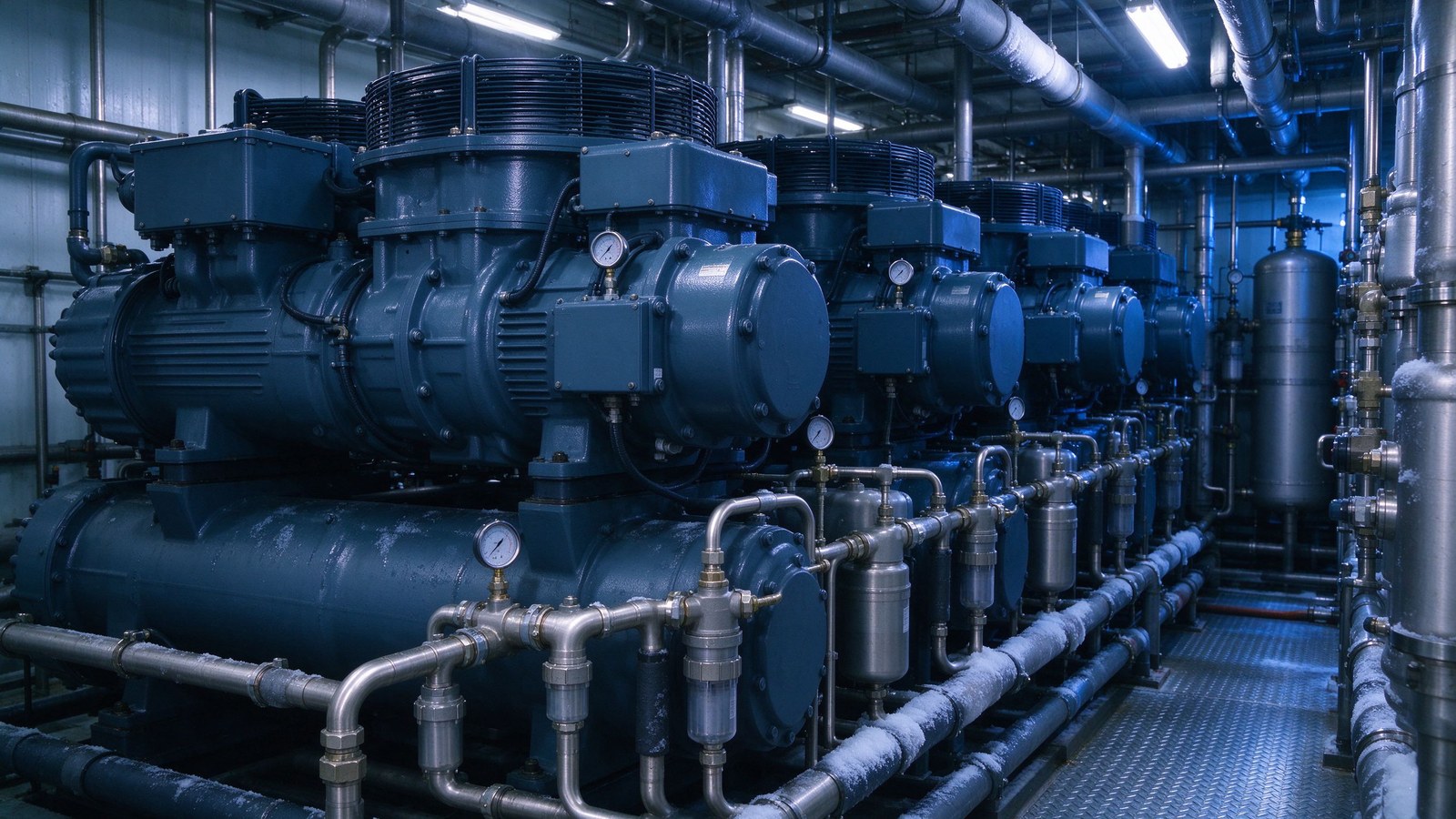
The refrigeration unit is the heart of a cold room. However good the panels and tight the doors, a mismatched unit defeats the whole system. When selecting a cold room unit, common questions are: reciprocating or screw compressor? Air-cooled or water-cooled? How much horsepower margin should be left? This article answers these questions at once.
1. Start with the Heat Load Calculation
The first step in selection is not the brand but the heat load. Heat load has four parts: heat transfer leaking through panels, infiltration heat and moisture from door openings and outside air, heat released as incoming goods cool down, and heat from people, lighting and equipment.
In practice, each item is calculated by room volume, temperature, daily intake and door-opening frequency, then a 10–20% margin is added as the design capacity. Owners can first use the online selection tool for an initial calculation and then check it with the contractor.
2. Core Differences Between Reciprocating and Screw Compressors
Reciprocating compressors compress refrigerant through cylinder reciprocation, with a mature structure, wide capacity coverage and good cost performance in the small-to-medium range; screw compressors compress through a pair of meshing rotors, running smoothly with high capacity and suiting long continuous operation. Their differences are shown below:
| Item | Reciprocating | Screw |
|---|---|---|
| Common capacity | 3–20 HP | Over 20 HP |
| Suitable room | Small/medium rooms | Large logistics rooms |
| Noise | Relatively higher | Lower and smooth |
| Efficiency | Slightly lower at part load | More economical over long runs |
| Maintenance cost | More wear parts (valves, rings) | Fewer wear parts, longer intervals |
| Initial investment | Lower | Higher |
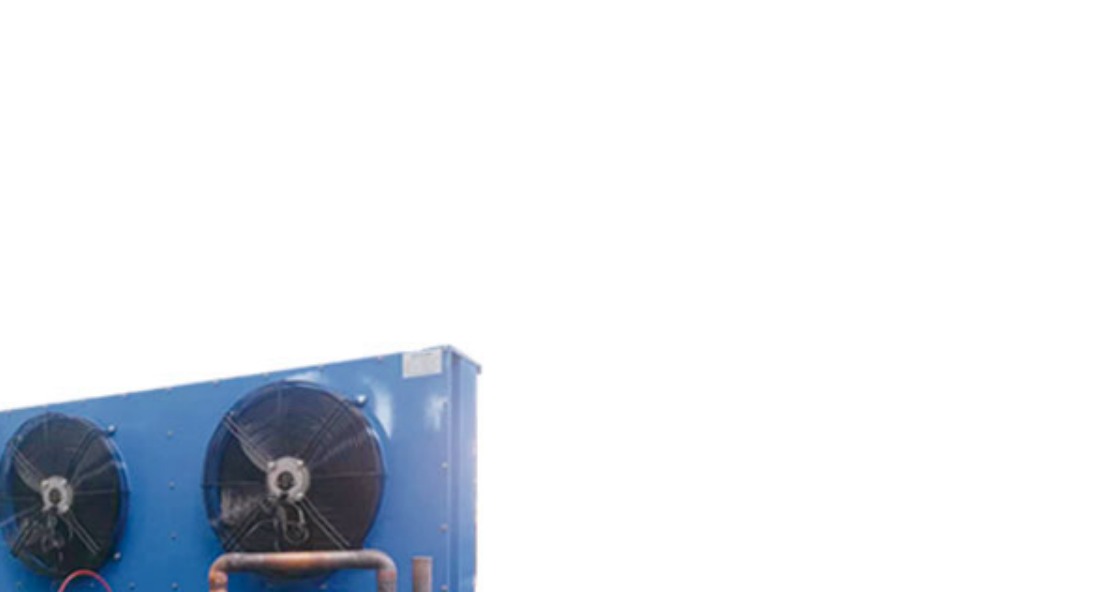
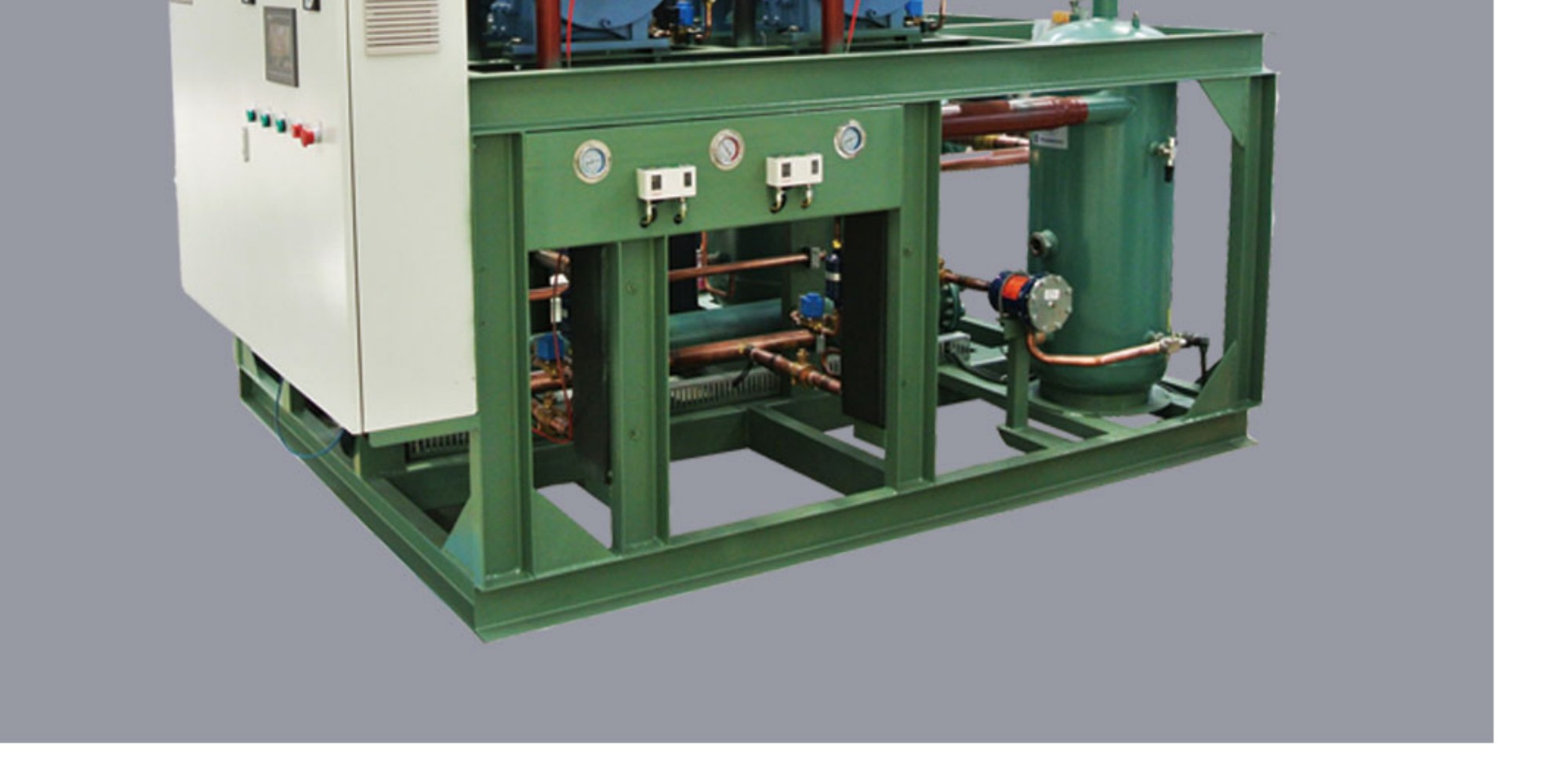
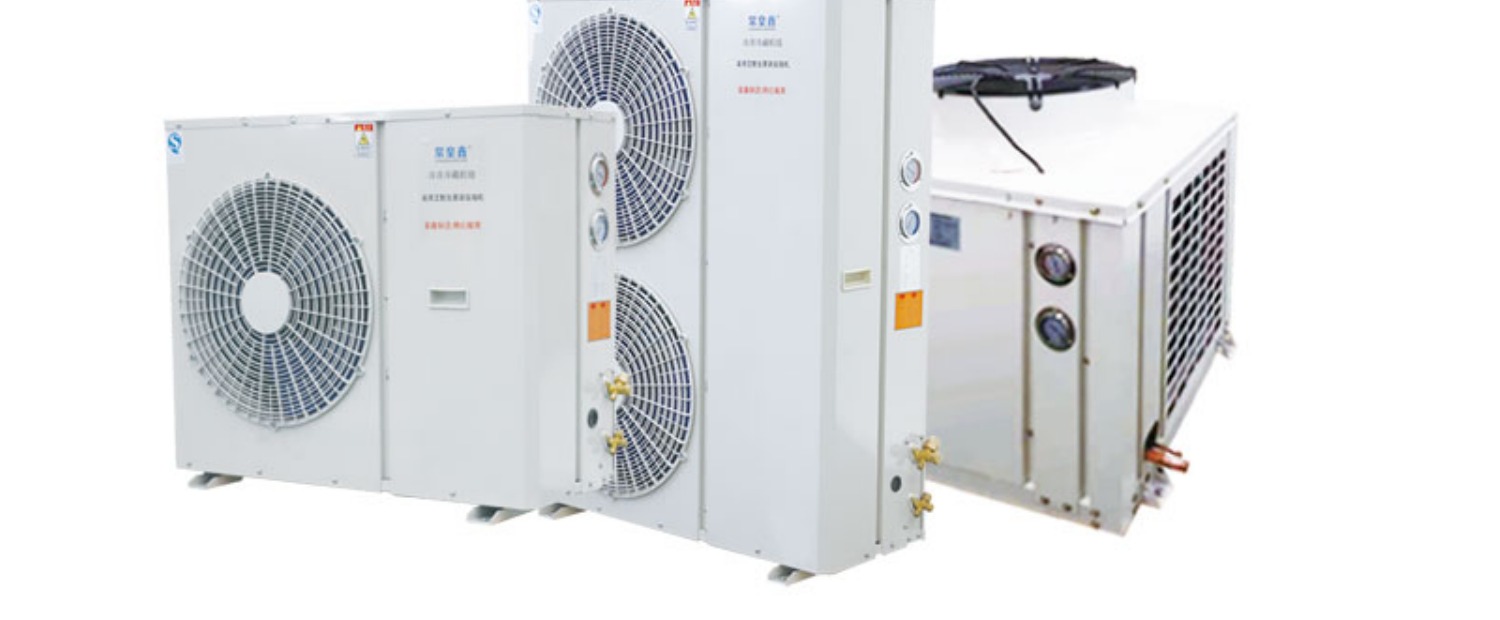
Industry rule of thumb: below 15 HP favor reciprocating, above 20 HP favor screw, and in between consider running hours and budget. For medium/high-temperature small rooms see our medium/high-temperature reciprocating unit; for large low-temperature projects see the air-cooled screw unit; for compact integrated solutions see the medium/high-temperature monoblock. More categories are in the refrigeration unit category.
3. Air-cooled vs. Water-cooled
Air-cooled units mount the condenser on the unit and dissipate heat with axial fans; simple to install and with no water-quality requirement, they are the mainstream for small and medium rooms. Water-cooled units need a cooling tower and pumps with higher initial investment, but offer more stable condensing temperature and slightly better efficiency, suiting 10,000-tonne logistics rooms or year-round hot regions.
Southern summer temperatures often exceed 35°C; air-cooled units need outdoor ventilation and shading to avoid high condensing pressure triggering protective shutdown.
4. More Horsepower Is Not Always Better
Many owners, worried about insufficient capacity, add horsepower one notch after another. In fact, oversized units cause three problems: frequent cycling with large temperature swings; increased risk of wet-vapor liquid return that damages the compressor over time; and both higher investment and energy costs.
The correct approach is to calculate the heat load and add a 10–20% margin. For example, if the calculated requirement is 10kW, an 11–12kW unit is enough; there is no need to jump to 15kW.
5. How to Balance Brand and After-sales
Top imported brands still have advantages in life consistency, noise control and global spare-parts networks, but with higher initial investment; domestic brands offer strong cost performance in the small-to-medium range with falling failure rates. When choosing, ask three things: is there authorized local after-sales, how fast common spare parts arrive, and how long the warranty is.
Do not overlook controls. Even a reliable unit alarms frequently if controls are poorly designed. A qualified control cabinet should include phase-sequence, overload and high/low-pressure protection, defrost control and temperature recording, with remote communication support.
6. Matching the Unit to the Room Type
Fresh-keeping rooms have high temperature and humidity, so units must handle dehumidification and defrost; freezer rooms run long-term low temperature and need low-temperature compressor oil; blast freezers must pull product temperature down quickly and need roughly double the capacity margin of ordinary freezer rooms; CA rooms, despite special gas composition, use ordinary fresh-keeping unit configuration but require airtightness maintenance.
For temperature differences across room types see CA vs. fresh-keeping rooms; for the share of units in total budget see how much a cold room costs; for unit configuration in large logistics rooms see our large logistics warehouse, and for panel thickness see cold room panel thickness and density.
7. Installation Location and Surroundings
Unit location is often underestimated. Air-cooled outdoor units should be in a ventilated, shaded place with at least 1 meter of service and discharge space front and rear, avoiding direct sun and hot-air short circuits. When multiple units sit side by side, spacing should be at least 1.5 meters to prevent discharged hot air being re-drawn by adjacent units.
Outdoor units dissipate heat with air in summer, and in cold northern winters need low-temperature running protection. Control cabinets should be placed in dry areas to avoid condensation; signal cables between the cabinet and unit should be routed separately from power cables to reduce interference. These details directly affect long-term stable operation.
FAQ
What size unit suits a 100m² fresh-keeping room?
Estimated at 0–5°C, 2.5m height and one intake a day, the capacity requirement is about 5–8kW, corresponding to a 3–5 HP air-cooled unit. With frequent door openings, high inlet temperature or hot summer regions, move up one notch to 6–8 HP. The heat load calculation should govern, avoiding both oversized and undersized units.
How do I choose between reciprocating and screw compressors?
For small/medium rooms below 15 HP with large temperature swings and frequent cycling, reciprocating units offer better value; for logistics rooms above 20 HP with long continuous operation and large volume, screw units have advantages in efficiency, vibration and life. In short, small rooms use reciprocating, large rooms use screw, and medium projects weigh running hours and budget.
What is the difference between air-cooled and water-cooled units?
Air-cooled units dissipate with air, are simple to install and low-maintenance, and suit small/medium rooms and water-scarce regions; water-cooled units use a cooling tower with slightly higher efficiency but need piping and water treatment, suiting large rooms and year-round hot regions. Under extreme southern summer heat, air-cooled condensing pressure runs high, so ventilation and shading need attention.
Does choosing a larger unit make it more durable?
No. Oversized units cycle frequently, swing in temperature and risk wet-vapor liquid return, which shortens life. Undersized units run full-load for long periods with frequent high-pressure alarms. The correct approach is to calculate the heat load and add a 10–20% margin rather than blindly increasing size.
Is there a big gap between imported and domestic units?
Top imported brands still have advantages in life, noise, efficiency consistency and parts supply; domestic units have shown strong cost performance in the small-to-medium range with falling failure rates. Choose based on project budget, local after-sales capability and spare-parts speed rather than blindly chasing premium brands.
What does routine unit maintenance involve?
Quarterly: clean condenser fins, check refrigerant leaks and oil level, and clear dust from control cabinets. Annually: replace the filter drier, measure insulation resistance and verify high-pressure protection. If shut down for over a month in winter, keep it dust-proof and powered off. Record running current and high-pressure values as a basis for fault prediction.
Frequently Asked Questions
What size unit suits a 100m² fresh-keeping room?
Estimated at 0–5°C, 2.5m height and one intake a day, the capacity requirement is about 5–8kW, corresponding to a 3–5 HP air-cooled unit. With frequent door openings, high inlet temperature or hot summer regions, move up one notch to 6–8 HP. The heat load calculation should govern, avoiding both oversized and undersized units.
How do I choose between reciprocating and screw compressors?
For small/medium rooms below 15 HP with large temperature swings and frequent cycling, reciprocating units offer better value; for logistics rooms above 20 HP with long continuous operation and large volume, screw units have advantages in efficiency, vibration and life. In short, small rooms use reciprocating, large rooms use screw, and medium projects weigh running hours and budget.
What is the difference between air-cooled and water-cooled units?
Air-cooled units dissipate with air, are simple to install and low-maintenance, and suit small/medium rooms and water-scarce regions; water-cooled units use a cooling tower with slightly higher efficiency but need piping and water treatment, suiting large rooms and year-round hot regions. Under extreme southern summer heat, air-cooled condensing pressure runs high, so ventilation and shading need attention.
Does choosing a larger unit make it more durable?
No. Oversized units cycle frequently, swing in temperature and risk wet-vapor liquid return, which shortens life. Undersized units run full-load for long periods with frequent high-pressure alarms. The correct approach is to calculate the heat load and add a 10–20% margin rather than blindly increasing size.
Is there a big gap between imported and domestic units?
Top imported brands still have advantages in life, noise, efficiency consistency and parts supply; domestic units have shown strong cost performance in the small-to-medium range with falling failure rates. Choose based on project budget, local after-sales capability and spare-parts speed rather than blindly chasing premium brands.
What does routine unit maintenance involve?
Quarterly: clean condenser fins, check refrigerant leaks and oil level, and clear dust from control cabinets. Annually: replace the filter drier, measure insulation resistance and verify high-pressure protection. If shut down for over a month in winter, keep it dust-proof and powered off. Record running current and high-pressure values as a basis for fault prediction.