
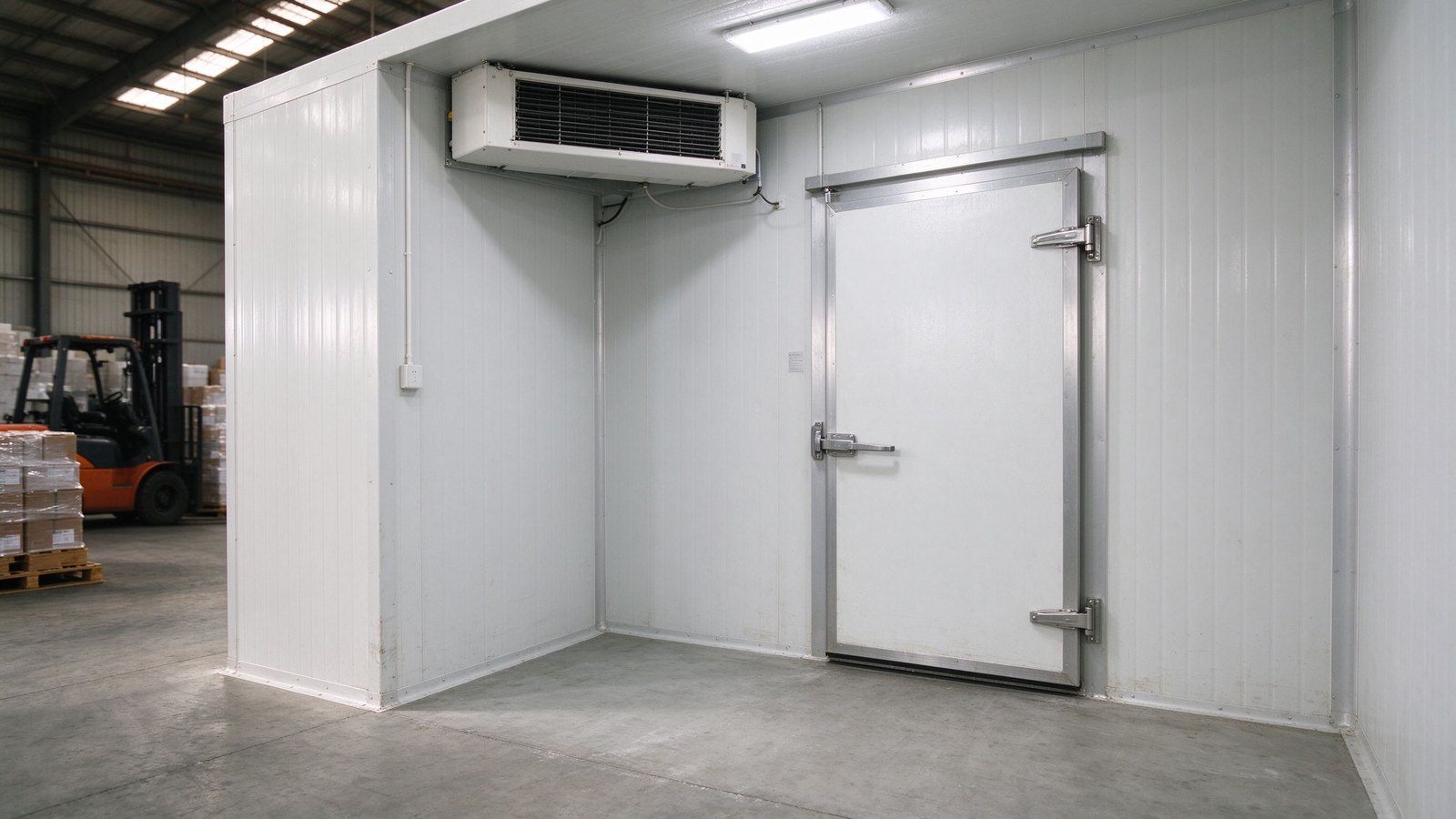
A cold room is an insulated, temperature-controlled room built to keep perishable goods at a set temperature. Walk into one and you're standing inside a refrigerator you can enter, but the idea is the same: keep heat out so food, medicine or other stock stays cold and lasts longer. The difference from a domestic fridge is scale. A cold room is built for pallets, trolleys and people to move around in, and its temperature and capacity can be designed around a specific operation rather than a kitchen.
Most cold rooms are assembled from interlocking insulated panels, a refrigeration unit, an evaporator and a control box, then fitted with a sealed door. This guide covers how they work, the parts that matter, the common types, and where each type earns its keep.
How a Cold Room Works
A cold room doesn't make cold. It moves heat. A refrigerant circulates through four components in a loop, picking up heat inside the room and releasing it outside:
- The compressor turns low-pressure refrigerant vapor into a hot, high-pressure gas.
- The condenser cools that hot gas until it becomes a liquid, shedding the heat into the outside air.
- The expansion valve drops the pressure of the liquid, which makes it cold.
- The evaporator blows room air across the cold coils. The refrigerant absorbs the heat, turns back into vapor, and the loop starts again.
The insulation's job is to slow the heat trying to get back in. The better the panels and the door seal, the less the compressor has to run, and the lower the electricity bill. That's why insulation quality matters more than buyers often assume.
The Main Components
Five parts do most of the work. Each is a separate decision, and getting one wrong drags down the rest.
- Insulated panels form the walls, ceiling and sometimes the floor. The foam core, usually polyurethane, and its thickness set how much heat leaks in. See the cold room panels range and our panel selection guide.
- The door is the weakest point for heat leakage because it opens and closes. Hinged, sliding and fast-roll doors suit different levels of traffic. Browse cold room doors.
- The refrigeration unit holds the compressor and condenser and sits outside the room. It has to match the room's heat load, not just its floor area. See refrigeration units.
- The evaporator, or air cooler, mounts inside near the ceiling and moves cold air around. Different coil and fin spacing handle different temperatures. See cold air fans.
- The control box runs the compressor, temperature, defrost and alarms. Basic boxes hold a set temperature; better ones log data and send alarms. See control systems.
Common Cold Room Types by Temperature
Temperature is the simplest way to tell them apart, because it drives both panel thickness and the refrigeration choice. These are the ranges you'll see quoted most often; the exact set point changes with the product stored.
| Type | Typical Temperature | What It Stores |
|---|---|---|
| Fresh-keeping / chilled room | 0 to 10°C | Fruit, vegetables, eggs, dairy, cut flowers |
| Medium-temperature room | -10 to -5°C | Chilled meat, poultry, deli goods, short-term storage |
| Freezer room | -25 to -18°C | Frozen meat, fish, seafood, ice cream, long-term storage |
| Blast freezer | -35°C and below | Quick-freezing fresh or hot product to lock quality and meet food-safety rules |
| Constant-temperature room | 15 to 25°C, controlled | Wine, chocolate, certain medicines and electronics |
Notice the overlap. A "chiller" in one warehouse may run at 2°C and in another at -8°C, so specify the temperature you need rather than ordering a type by name.
Where Cold Rooms Are Used
They turn up wherever spoilage or temperature rules cost money:
- Restaurants, hotels and catering use walk-in chillers and freezers to hold bulk ingredients close to the kitchen.
- Supermarkets and convenience stores run back-of-house cold rooms to restock the display cases.
- Meat, seafood and poultry processors need chilled rooms for handling and freezer rooms for finished stock, often with a blast freezer in the line.
- Fruit and vegetable distributors use fresh-keeping and controlled-atmosphere rooms to extend shelf life across long transport.
- Pharma and healthcare rely on validated 2 to 8°C rooms for vaccines and medicines, with logging and alarms.
- Logistics and cold-chain warehouses run large multi-zone rooms to sort and cross-dock frozen and chilled cargo.
Three Mistakes Buyers Make
Having helped size a lot of these rooms, the same few errors come up again and again. They're worth fixing on paper before you commit to a layout.
1. Sizing for today's stock, not next year's. A room that's full on day one has nowhere to grow, and adding capacity later means a second unit or a new build. Leave headroom in both floor space and refrigeration load.
2. Chasing the lowest panel price. Cheap panels with thin steel or low-density foam leak more heat and dent easily. The day-one saving shows up as higher running costs for years. Ask for density and steel thickness, not just the price per square meter.
3. Treating colder as better. Running a freezer at -25°C to store vegetables that only need 2°C wastes energy and can damage the product. Match the temperature to the goods, and use separate zones if you store different products.
If you're not sure which type fits your product and volume, tell our engineers what you're storing, how much, and the local climate. We'll work out the temperature, size and refrigeration load rather than selling a generic kit. You can also read about how cold room pricing works and the build process from survey to handover.
Frequently Asked Questions
What is the difference between a cold room and a walk-in cooler?
Mostly a naming difference. A walk-in cooler usually means a room you can walk into that runs above freezing, while cold room is a broader term covering both chillers and freezers. Pay attention to the operating temperature, not the name, and confirm it matches the product you store.
How long does it take to install a cold room?
A standard modular cold room can be assembled in a few days once the panels and equipment arrive on site, because the panels are prefabricated. Design, manufacturing and shipping take longer, usually a few weeks depending on size and customization. Turnkey or built-in-place rooms take longer than modular ones.
Can a cold room be disassembled and moved?
Yes for modular panel rooms joined with eccentric hooks. They can be taken down and reassembled, which is one reason they are popular. Built-in-place rooms using spray foam or masonry cannot be moved. Relocating a modular room also means re-siting the refrigeration and re-commissioning the system.
Does a cold room need a special floor or foundation?
Small chillers often sit on a level, damp-proof concrete floor and use the building floor. Freezer rooms and areas with pallet-jack or forklift traffic usually need an insulated, reinforced floor or floor panels to prevent frost heave and carry the load. Tell us the equipment that will move inside and we'll specify the floor.
What temperature should I set for my products?
It depends on the product. Vegetables and dairy often run at 0 to 5°C, frozen stock at -18°C or colder, and vaccines at 2 to 8°C. Give us the product and the storage period, and we'll confirm the set point and, where it matters, the humidity.
How much electricity does a cold room use?
There is no single figure. It depends on room size, temperature, insulation, how often the door opens and the ambient climate. A well-insulated, correctly sized room runs far less than an oversized or leaky one. Once we know the heat load, we can estimate the running cost so you can compare it against quotes.