
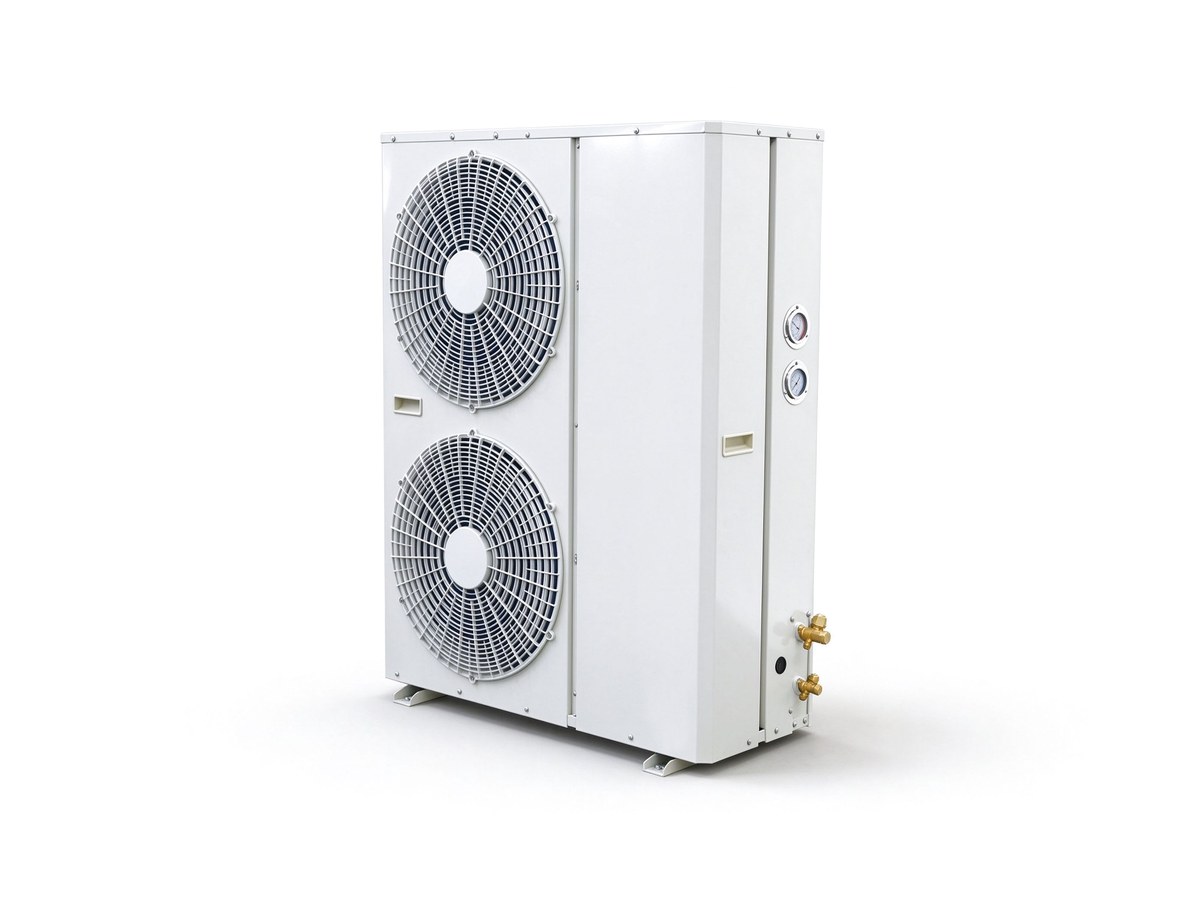
Cold room energy consumption is the electricity a refrigeration system uses to move heat out of the room and reject it into the air outside. It is set by how much heat gets in through the envelope, how much the product brings, and how hard the compressor has to work to push that heat out at the ambient temperature of the day. Owners usually watch the room temperature and the bill. The gap between those two numbers is where the savings sit.
This guide breaks the bill into parts you can measure, then into the levers that change them. It is written for operators in hot climates, where the gap between design and reality is widest.
The four heat loads that set the bill
Every kilowatt hour starts as heat that has to be removed. Four paths bring it in, and each has a different owner.
1. Transmission through panels, floor and ceiling
Heat passes through the envelope at a rate you can calculate: Q equals U value times area times temperature difference. A 100 m² wall of 100 mm PU panel, U around 0.24 W/m²K, passes about 1.08 kW at 45 K. Scale up to a 6 × 5 × 3 m freezer at -18 °C in 45 °C ambient: roughly 130 m² of surface, 63 K across the panel, close to 2 kW running every hour, before anything is loaded and before a door opens.
That number is why panel thickness matters more in the Gulf and Southeast Asia than in Europe. A 150 mm panel brings U down to about 0.16 and cuts transmission by roughly a third on the same room. Run the payback with your own tariff and hours; the panel thickness guide has the comparison.
2. Infiltration through doors
Every door opening swaps cold dry air for warm humid air. That warm air carries sensible heat and water vapour, and the water ends up as frost on the coil, which the next defrost has to melt. A dispatch door that opens forty times a shift can carry more load than the walls. High-speed doors and well fitted strip curtains cut the exchange time, and door discipline cuts the number of openings. Hardware is covered in cold room door selection.
3. Product load
Product enters warm and has to be cooled, and fresh produce keeps generating heat while it sits. As a working figure, taking 1 kg of meat from +10 °C to -18 °C removes around 300 kJ, about 0.08 kWh of compressor work at perfect efficiency and more in practice. Throughput matters more than room volume: a store that turns stock every two days runs a very different load profile from one that holds frozen stock for months. Fruit and vegetables add respiration heat, which is why pre-cooling before storage pays for itself.
4. Internal loads
Evaporator fans, condenser fans, defrost heaters, lights, people and forklift trucks all put heat inside the room or draw power directly. Fans are the second largest line on most bills, defrost heaters the third.
| Where the electricity goes | Indicative share | What moves it | How to check on site |
|---|---|---|---|
| Compressor work | 55% to 70% | Suction and condensing pressure, part-load control, setpoints | Sub-meter the compressor circuit for seven days |
| Evaporator fans | 10% to 18% | Fan motor type, speed control, hours run including defrost | Sub-meter the evaporator fan circuit |
| Defrost | 5% to 12% | Defrost method and termination, door traffic, humidity entering | Log defrost cycles and duration per day |
| Condenser fans | 5% to 10% | Ambient temperature, fin condition, fan control strategy | Read discharge pressure at the hottest hour |
| Lights and other | 2% to 5% | Lamp type, lights left on, door left open | Walk the room after closing time |
These shares are indicative ranges. They shift with climate, room size, product and door traffic, so treat your meter data as the authority and this table as the map.
Condensing temperature is the biggest lever within reach
Compressor power climbs with condensing temperature. A widely used rule of thumb is that 1 K lower condensing temperature cuts compressor power by about 2% to 4%, depending on refrigerant and unit type. On a 45 °C afternoon the condenser is the part working against you, and the penalty is paid every hour of the season.
Three things push condensing temperature up in real buildings:
- Fouling. Dust and grease on the fins add 3 K to 8 K. A condenser cleaned twice a year in a dusty market or port area holds its design point far better than one cleaned when someone remembers.
- Undersized condensers. A condenser selected for 40 °C ambient in a 48 °C climate will run hot all summer. Selecting for the real summer ambient costs more once and less every month. Our U-shaped air cooled condenser is sized to the site condition rather than a catalogue default.
- Fixed head pressure control. Holding a constant high discharge pressure at night, when ambient drops 15 K, throws away free capacity. Floating head pressure control lets the system follow ambient where the expansion valve allows it.
The suction side works the same way in reverse: 1 K higher evaporating temperature saves roughly 2% to 3% of compressor power. Raising it only works if the product and the humidity allow it, and if the coil still holds room temperature at the hottest part of the day.
The compressor and unit selection sets how much of this you can recover. Reciprocating units hold part-load efficiency in small and medium rooms, while screw units with variable speed drive suit large warehouses with long part-load hours. Our refrigeration units cover both, and we size them on the design condition rather than on horsepower alone.
Settings you can change this week, at no cost
- Defrost on demand, not on a timer. Fixed schedules defrost coils that are already clean. A demand or pressure-based termination cuts both heater energy and the heat it puts back into the room.
- Night setback. A frozen store with no traffic overnight can run 1 K warmer without touching product quality. Confirm with your product and your food safety plan first.
- Fan run-time. Evaporator fans that run through defrost add heat exactly when the coil is trying to melt frost. Fan cycling during defrost is a standard control function, and worth checking on older panels.
- Door discipline. Close the door, keep strip curtains intact, and stop propping doors open during picking. This costs nothing and shows up in the defrost log within a week.
- Lights. LED lamps and a switch-off routine cut a small line, and the heat the lamps add inside the room.
Measure for seven days before you spend money
A clamp meter and a three-phase kWh logger settle arguments that a walk-through cannot. Log the whole room for a week, and sub-meter the compressor, evaporator fans and condenser fans where the panel allows. Record ambient temperature, door openings and product intake for the same week so the numbers can be read against what the room was doing.
| What to meter | Instrument | What it reads | What you do with it |
|---|---|---|---|
| Whole room | kWh meter or logger on the main circuit | Total energy and load shape | Benchmark per m³ and per tonne handled |
| Compressor | Clamp meter with logging | Duty cycle and average draw | See how much time is spent at part load |
| Discharge pressure | Gauge or manifold reading | Condensing temperature | Compare against ambient, spot fouling and undersizing |
| Suction pressure | Gauge or controller reading | Evaporating temperature | Check setpoint, valve and coil condition |
| Door openings | Reed switch and counter, or manual tally | Openings per shift | Quantify infiltration and the case for a faster door |
Put the monthly figure in money and the conversation changes. A room drawing 20 kW average uses 14,400 kWh a month, which is USD 1,728 at USD 0.12 per kWh. Those numbers are illustrative, so use your own tariff. A 10% cut is USD 2,074 a year, and the free measures above get a good part of the way there.
When the fix is hardware rather than habits
Some losses will not respond to a checklist. High condensing temperature all afternoon points to the condenser or the unit. Heavy defrost cycles point to the door or the coil. A room that cannot hold temperature at peak ambient points to the envelope or the capacity.
The hardware levers, in the order we usually recommend: a larger or better controlled condenser first, because it is cheap relative to the saving; a high efficiency evaporator with inner grooved tubes and EC fans next, because fan energy and coil performance improve together; then the unit, where variable speed drive pays back on long part-load hours; then the envelope, where thicker panels and faster doors cut load permanently. Our high efficiency evaporator, high speed door and panel range pages carry the specs.
Tropical and Gulf detail: humidity, not temperature, drives defrost load. A room in Jakarta or Jeddah sees far more moisture per door opening than the same room in a dry climate, so defrost method and door speed matter more there. Background is in our article on cold rooms in tropical climates.
What we need to price a fix
To quote a retrofit or replacement we need: room dimensions and panel thickness, product type and daily intake, current setpoints and defrost method, ambient design temperature, the existing equipment list with compressor and condenser model numbers, your tariff, and any meter data. Photos of the plant room and door area help more than descriptions. Where a figure is missing we mark it to be confirmed rather than guess.